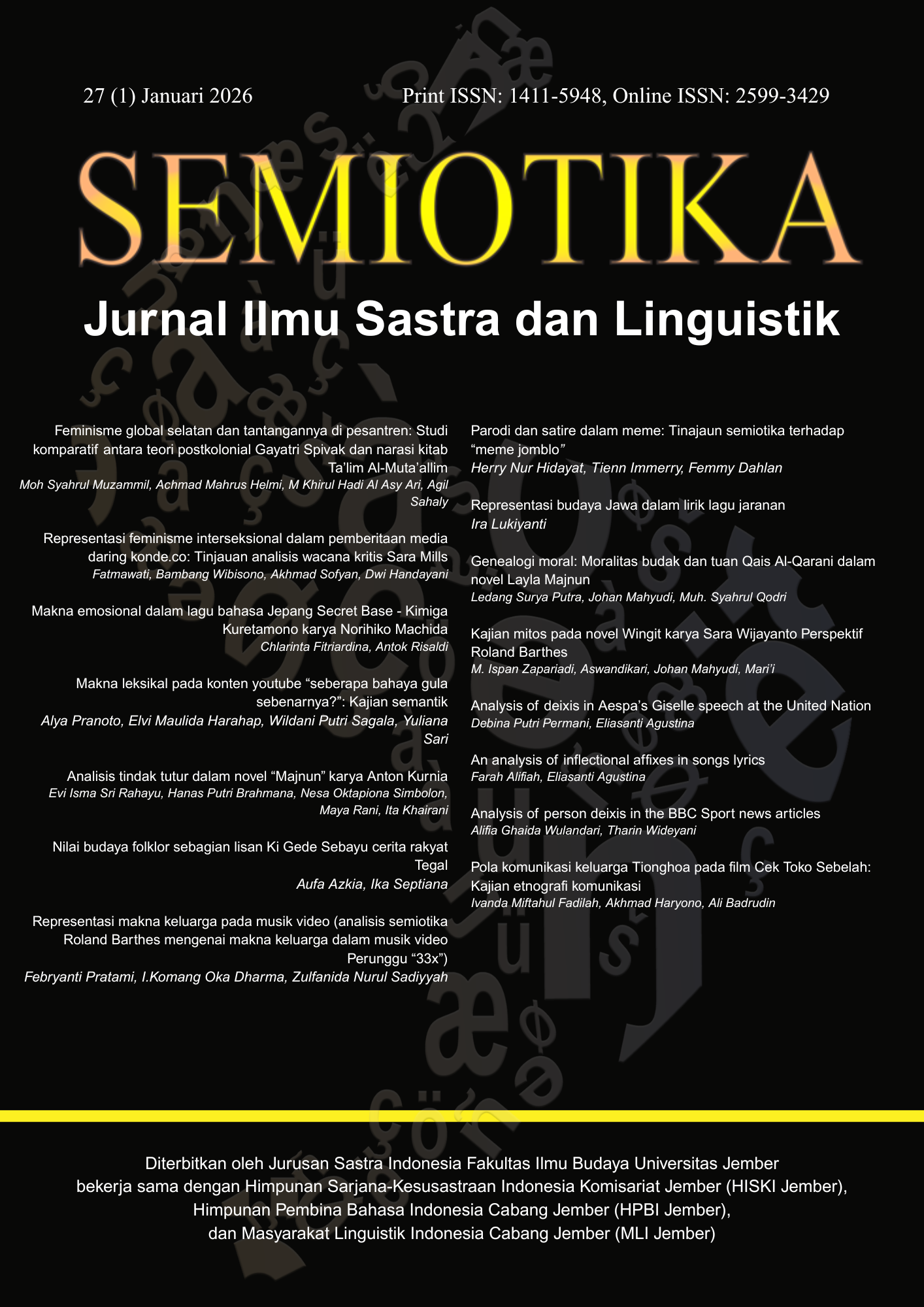
Pola komunikasi keluarga Tionghoa pada film Cek Toko Sebelah: Kajian etnografi komunikasi
Keywords:
Budaya, Film, Keluarga, Komunikasi, TionghoaAbstract
Penelitian ini bertujuan mengungkap nilai-nilai budaya Tionghoa yang terwujud melalui pola komunikasi keluarga pada film Cek Toko Sebelah. Penelitian menggunakan metode deskriptif kualitatif dengan pendekatan etnografi komunikasi. Data berupa dialog antaranggota keluarga, yang dikumpulkan melalui metode dokumentasi yang kemudian diklasifikasikan berdasarkan temuan pola dan dianalisis menggunakan model SPEAKING Dell Hymes untuk mengidentifikai komponen situasi tutur. Hasil penelitian menunjukkan empat pola utama komunikai keluarga dalam film. Pola hierarkis-paternalistik menegaskan bahwa ayah memiliki wewenang untuk membuat keputusan. Pola negosiasi nilai menunjukkan perbedaan antara tradisi keluarga dan pendekatan orientasi anak zaman sekarang. Pola konflik horizontal yang menggambarkan interaksi antarsaudara yang egaliter dan ekspresif. Pola restoratif sebagai upaya mengembalikan keseimbangan melalui permohonan maaf. Keempat hasil tersebut menunjukkan bahwa komunikasi keluarga Tionghoa di Indonesia dalam film berfungsi sebagai cara untuk menyebarkan nilai filial piety, mengatasi pengelolaan konflik, dan pemeliharaan keutuhan keluarga.
Downloads
References
[1] Bedford, O., & K-H. Yeh. (2021). Evolution of the Conceptualization of Filial Piety in the Global Context: From Skin to Skeleton. Frontiers in Psychology. 12: 5705447. https://doi.org/10.3389/fpsyg.2021.570547
[2] Chadwin, J. (2023). Contemporary Filiality and Popular Religion: An Ethnographic Study of Filiality Among Chinese University Students and Their Parents. Journal Open Theology. 9: 20220238. https://doi.org/10.1515/opth-2022-0238
[3] Gu, C., & Z. Li. (2023). The Confucian Ideal of Filial Piety and Its Impact on Chinese Family Governance. Journal of Sociologi and Ethnology. 5(2): 45-52. https://doi.org/10.23977/jsoce.2023.050208
[4] Guan, S., F. Meng., & C. Wu. (2025). Authoritative Filial Piety Rather than Reciprocal Filial Piety Mediated the Relationship Between Parental Support, Career Decision Self-Efficacy, and Discrepancies Between Individual-Set and Parent-Set Carer Goals. Journal Behaviorak Sciences. 15(8), 1135. https://doi.org/10.3390/bs15081135
[5] Han, X., & M. Cheung. (2024). The Relationship Between Dual Filial Piety and Mental Disorders and Symtoms Among Adolescents: A systematic Review of Quantitative and Qualitative Studies. Adolescent Research Review. 10: 31-45. https://doi.org/10.1007/s40894-024-00234-2
[6] Li, W. W., et al. (2021). Mental Health of Chinese People During the COVID-19 Pandemic: Associations with Infection Severity of Region of Residence and Filial Piety. Frontiers in Psychology. 12: 633452. https://doi.org/10.3389/fpsyg.2021.633452
[7] Qiao, X., et al. (2021). Chaos May Prevail Without Filial Piety: A Cross-Cultural Study on Filial Piety, the Dark Triad, and Moral Disengagement. Frontiers in Psychology. 12: 738128. https://doi.org/10.3389/fpsyg.2021.738128
[8] Rubi, R. M., et al. (2025). Nilai-nilai Kekeluargaan dalam Film Komedi Indonesia: Analisis Film Cek Toko Sebelah. CONVERSE: Journal Communication Science. 2(1): 1-14. https://doi.org/10.47134/converse.v2i1.4550
[9] Sulistyawati. (2024). Representation of Indonesian Speech Activities in Classroom Learning: A Study of Communication Ethnograpy. in Proceedings of the 3nd annual Internatioan Conference on Natural and Social Science Education (ICNSSE 2023). Advances in Social Science, Education and Humanities Research 846. Hal. 172-179. https://doi.org/10.2991/978-2-38476-242-2_8
[10] Tamba, W. P., & F. Nugroho. (2024). Intervensi Assessment Masalah dalam Film “Cek Toko Sebelah”. Jurnal Intervensi Sosial dam Pembangunan (JISP). 5(2): 120-134. https://doi.org/10.30596/jisp.v5i2.21075
[11] Wu, X. (2023). Negotiating Filial Care in Transitions: an Ethnograpic Sutdy of Family Involvement in China’s Nursing Homes. The Journal of Chinese Sociology. 10(9): 1-18. https://doi.org/10.1186/s40711-023-00187-4
[12] Yang, Q. (2022). Ethnography of Communication Analysis of Ph.d Student’s on-Line Group Discussion. Journal of Sociology and Ethnology. 4(1): 108-113. https://doi.org/10.23977/jsoce.2022.040122
[13] Zamralita., A. P. L. Wilis., & S. Angelina. (2024). The Role of Family Resilience on Family Functioning with Family Communication as Mediator in Generation Z. Jurnal Komunikasi. 16(2). https://doi.org/10.24912/jk.v16i2.30434
[14] Zheng, W., et al. (2021). The Prosocial Outgrowth of filial Belief in Different Cultures: A Conditional Mediation Model Analysis. Frontiers in Psyuchology. 12: 748759. https://doi.org/10.3389/fpsyg.2021.748759
Downloads
Published
Issue
Section
License
Copyright (c) 2026 JURNAL SEMIOTIKASEMIOTIKA has CC-BY-SA or an equivalent license as the optimal license for the publication, distribution, use, and reuse of scholarly work. Authors who publish with this journal retain copyright and grant the journal right of first publication with the work simultaneously licensed under a Creative Commons Attribution-ShareAlike 4.0 International License that allows others to share the work with an acknowledgment of the work's authorship and initial publication in this journal.

Attribution-ShareAlike
CC BY-SA